
When you think of a “strong immune system,” what typically comes to mind?
Perhaps you picture bottles of Vitamin C, drinking warm tea with honey, or diligently washing your hands to avoid germs. You might think of your white blood cells fighting off invaders like microscopic soldiers.
You probably never thought of your biceps, quadriceps, or glutes.
For decades, traditional medicine viewed skeletal muscle merely as a mechanical tool—a system of pulleys and levers designed solely to move our bones. However, a groundbreaking shift in modern physiology has revealed a deeper, more profound truth: Your muscles are actually your body’s largest Endocrine Organ.
They don’t just move you; they protect you. Today, we explore the fascinating, life-saving connection between your muscle and immune system—and why losing muscle mass might be the real reason you stay sick longer as you age.
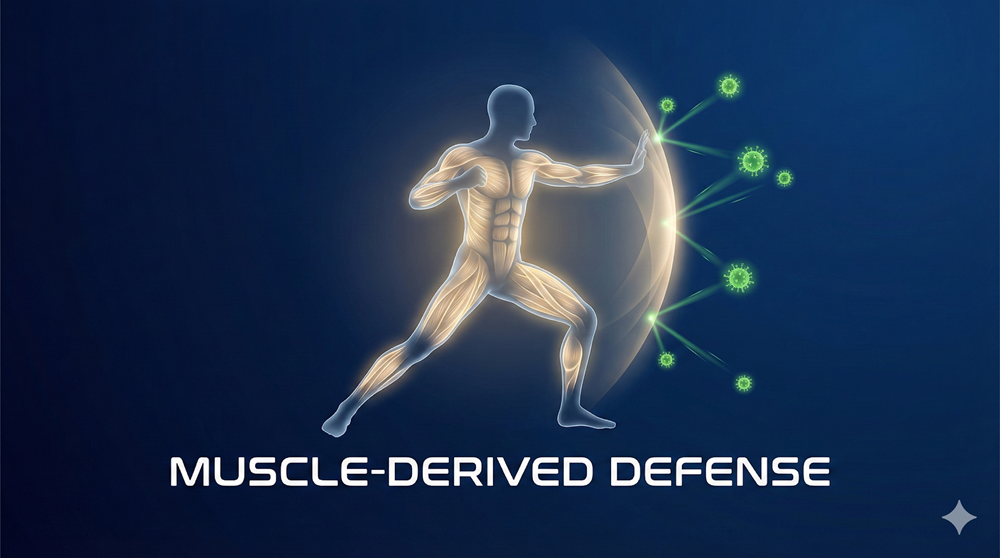
The Paradigm Shift: Muscle as an Organ
To understand why you need muscle to survive the flu season, we must first change how we define it.
Muscles are not just lifeless slabs of meat. They are metabolically active tissues. When your muscles contract during exercise—whether it’s walking, gardening, or performing safe resistance training—they release powerful signaling proteins called Myokines.
Think of Myokines as text messages sent from your muscles to the rest of your body. These chemical messengers travel through the bloodstream to communicate with your liver, your brain, and most importantly, your immune system.
Research published in leading medical journals has confirmed that these Myokines play a direct role in regulating immune responses. They help “wake up” your immune cells when a threat is detected and, crucially, help calm them down when the threat is over.
The Science: How Muscle and Immune System Communicate
Let’s dive into the biology. When your muscles contract during exercise, they release signaling proteins called Myokines.
Think of Myokines as text messages sent from your muscles to the rest of your body. These chemical messengers travel through the bloodstream to reduce inflammation and activate your immune cells.
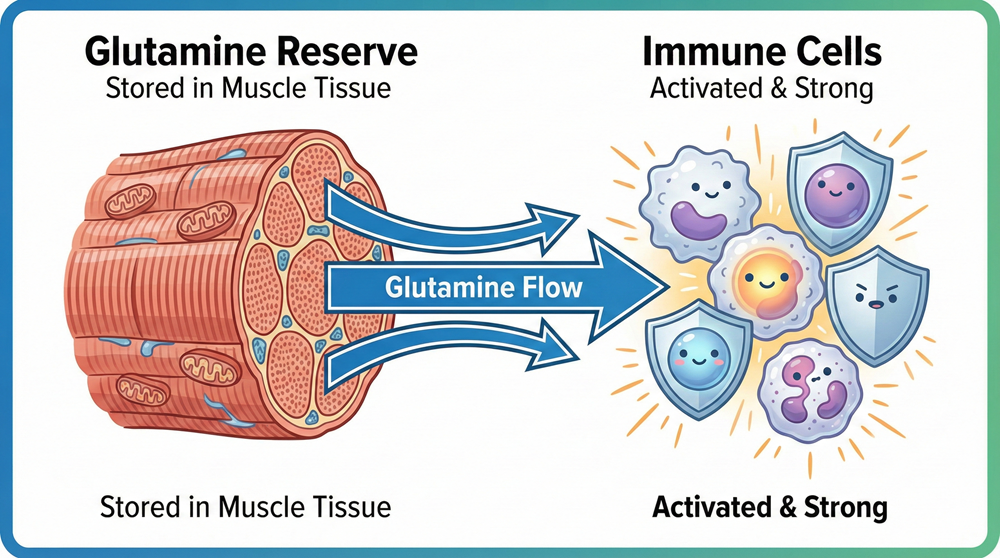
However, the relationship goes even deeper than that. Your muscles act as a “bank account” for your immune system.
Glutamine: The Fuel of War
When you get sick—whether it’s a flu, an infection, or recovery from surgery—your immune system goes to war. Like any army, it needs massive amounts of fuel to produce white blood cells and antibodies.
The specific fuel it needs is an amino acid called Glutamine.
Here is the catch: Your immune system cannot produce enough Glutamine on its own during high-stress situations. It has to borrow it. And where is the largest storage of Glutamine in the body?
Your muscles.
If you have healthy muscle mass, your body borrows some Glutamine, fights the infection, and you recover quickly. This is why muscle is often called the “Reserve of Life.”
The Crisis: Low Muscle Mass = Compromised Immunity
This brings us back to the danger of Sarcopenia.
If you have allowed your muscle mass to dwindle over the years, you are essentially facing a war with an empty bank account.
When a virus strikes a senior with low muscle mass:
- The body tries to draw Glutamine from muscles, but the reserves are low.
- To get enough fuel, the body enters a severe state of Catabolism (cannibalizing remaining muscle aggressively).
- The immune response becomes weak and sluggish due to fuel shortage.
This explains why a common flu might knock a 30-year-old down for 3 days, but might hospitalize a 70-year-old for 3 weeks. The difference isn’t just “age”; it is the “resource availability” stored in their muscles.

Building Your Defense
The takeaway is empowering: You can boost your immunity by building muscle.
Every time you perform safe resistance training, you are not just toning your arms; you are restocking your body’s emergency medical supplies.
Action Plan:
- Move Daily: Stimulate those Myokines.
- Protect Your Reserves: Ensure you are absorbing enough protein (using high-absorption amino acids) so your body doesn’t have to eat its own muscle shield.
Coming Up Next: Now that we have fortified your body, it is time to look at the “Command Center.” In our next series, we will shift our focus to Brain Health, starting with a question that scares everyone: Is it simple forgetfulness, or something worse?